

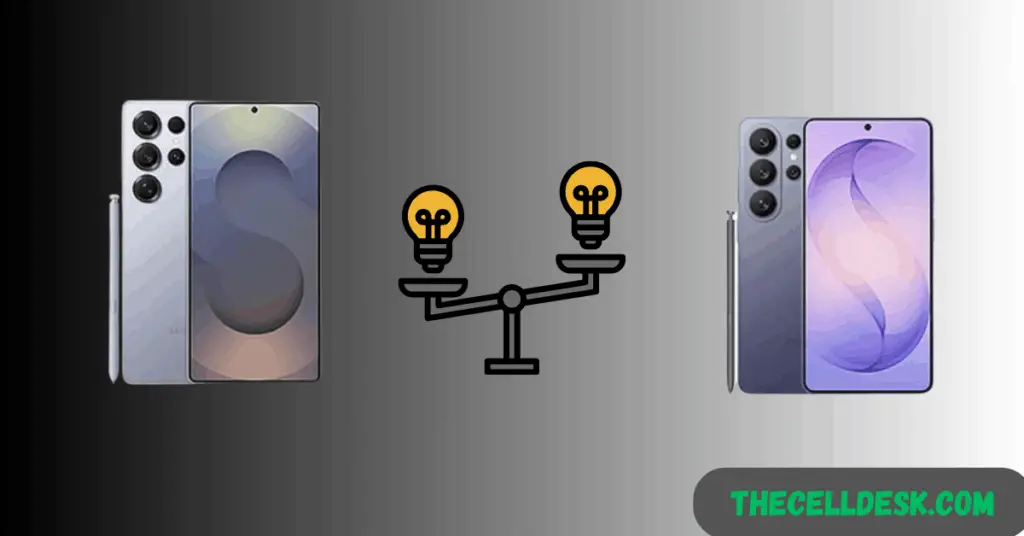
Samsung’s Ultra lineup has long been known for industry-leading displays. The Galaxy S25 Ultra delivered exceptional brightness, near-perfect viewing angles, and advanced anti-reflective coating.
With the introduction of directional privacy hardware in the S26 Ultra, comparisons are inevitable.
Let’s examine the key differences.
Peak Brightness
The S25 Ultra achieved extremely high peak brightness levels, making it one of the best outdoor-readable smartphones of its generation.
The S26 Ultra, however, introduces privacy-focused display architecture. When privacy mode is activated:
- Sub-pixel masking may reduce effective luminance
- Light emission angles narrow
- Peak brightness perception can drop
In normal mode, brightness should remain competitive, but real-world testing is necessary to confirm whether embedded layers slightly impact total light output.
Viewing Angles
The S25 Ultra offered wide viewing angles with minimal luminance drop-off and almost no color distortion at tilt.
Directional pixel displays in the S26 Ultra narrow the viewing cone intentionally. This may lead to:
- Earlier brightness falloff at moderate angles
- Side-view dimming
- Slight white balance shift at tilt
For users who frequently share their screen, this is the most noticeable potential difference.
Color Accuracy & White Shift
Color shift occurs when light diffusion changes across angles.
If the S26 Ultra’s privacy layer remains partially active even when the feature is disabled, some subtle off-axis color differences could exist.
Straight-on color performance is expected to remain flagship-grade, but viewing angle uniformity may not match the S25 Ultra’s standard.
Anti-Reflective Coating
The S25 Ultra introduced strong glare resistance, improving outdoor readability.
If the S26 Ultra modifies the display stack to integrate privacy hardware, coating performance may differ slightly.
Even minor coating changes can affect perceived clarity in bright conditions.